

Building the Next Generation of STEM Leaders Through Culturally Responsive Practices at Science Club
October 8, 2026
This article is featured in the fall 2026 Issue of the Mentoring Research Roundup, our quarterly series spotlighting new research and scholar interviews on youth mentoring. To dive deeper into the latest findings shaping the field, visit the Mentoring Research Roundup.
One of the persistent challenges within science, technology, engineering, and math (STEM) fields is the underrepresentation of certain racial and ethnic groups, which limits the talent pool available to employers and perpetuates inequities across many industries. While there has been considerable effort to address these disparities over the last quarter century, meaningful change has been hard to come by, particularly within the educational pathways that lead to long-term STEM careers. One study found only 7% of STEM degrees were awarded to Black students and 12% to Hispanic students in one academic year, rates far below their degree attainment in other fields (Pew Research Center, 2021).
This can become a self-sustaining problem — the fewer minority representatives within science-related fields, the harder it can be for racially minoritized students to see themselves as potential future scientists. They lack examples, both in real life and in the media they consume, that challenge their preconceptions of what a scientist looks like or the types of people who become STEM professionals in our society. Young people may not pursue STEM careers if it does not feel like a “possible future” that applies to them.
There have been many concerted efforts to address this problem by introducing youth to STEM mentors early in their education, both to get them excited about doing science activities and to, hopefully, provide them with role models that broaden their perceptions about the career pathways available to them. These programs have grown in scale in recent years and here at MENTOR we have partnered with leading STEM mentoring providers to identify the best practices that can make STEM mentoring more impactful. Unfortunately, one persistent challenge that these programs can face is that those STEM professionals who do volunteer as mentors often lack the backgrounds or skills that allow them to engage racially minoritized youth in culturally relevant and responsive ways (Stelter et al., 2021).
One program taking on this challenge is Science Club, an innovative mentoring program set in Chicago-area Boys and Girls Clubs that is working to address underrepresentation in STEM fields and ensure that the STEM mentoring experiences of young people not only build their science skills and interests, but do so in ways that are culturally responsive and relevant to the diverse youth in the program.
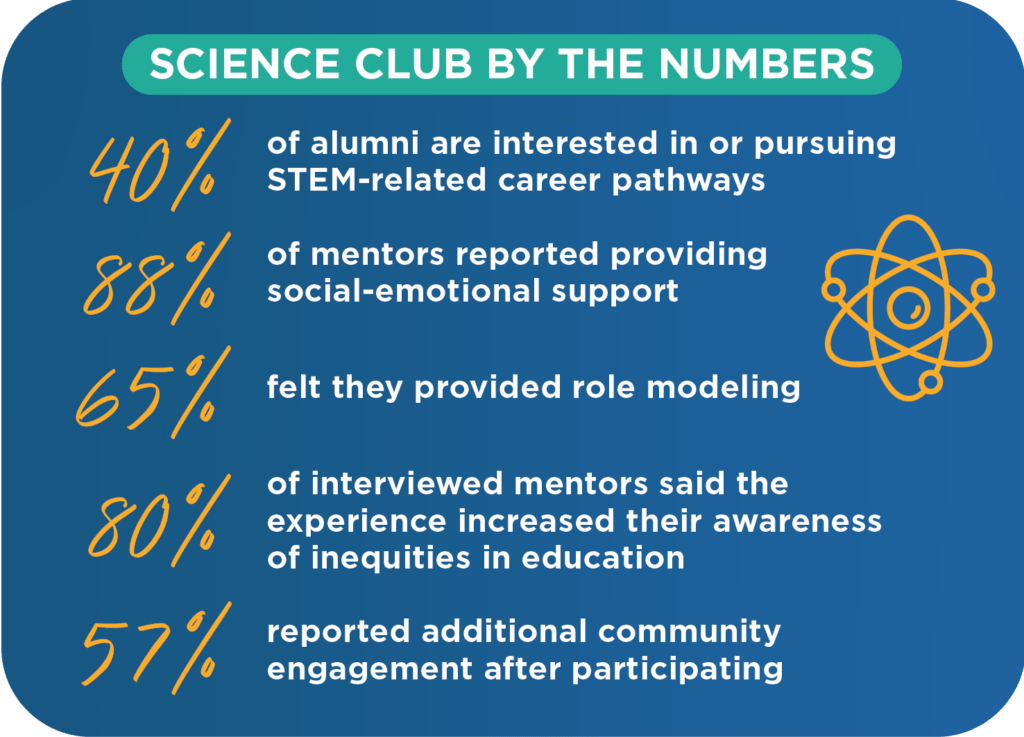
And it’s hard to argue with the results: the initial pilot of the program a decade ago found that 30% of Science Club alumni were pursuing STEM careers, compared to just one percent of the non-participating alumni of the same Club site (Garibay & Schaefer, 2015; Kennedy et al., 2016). More recent data from the program’s ongoing National Science Foundation (NSF) study finds that 40% of Science Club alumni are interested in or pursuing STEM-related career pathways — for comparison, only 18% of adults work in STEM-related careers. The program even has an impact on those not considering science fields: 60% of those interested in media and social science, arts, and the trades all reported the program inspired their interest in those fields at some level. Changing the historically low representation in these fields starts with programs doing exactly this type of early engagement in STEM.
The peer-reviewed article, “Culturally Responsive Practices in a Science Mentoring Program Serving Racially Minoritized Youth” by Dr. Bernadette Sánchez and colleagues (Sánchez et al., 2026) explores the culturally responsive practices used by mentors in Science Club, which serves primarily Black and Latinx youth from underserved communities in Chicago. As part of that NSF study, the research team surveyed 142 former scientist-mentors, all of whom were STEM majors at Northwestern University and had participated in the program for at least a year between 2009 and 2019. They also conducted in-depth interviews with a subgroup of 35 to understand exactly how mentors supported youth, the ways they had engaged young people, and what they themselves had gained from the experience.
Through these interviews, the research team identified three key practices central to culturally responsive mentoring within the Science Club model: 1) providing social-emotional support, 2) serving as a role model, and 3) engaging in youth-oriented science communication — essentially making science more accessible by connecting concepts to youth interests and experiences. High percentages of mentors reported employing these practices during their time in the program, including 88% who provided social-emotional support and 65% who felt they provided role modeling.
These practices may seem somewhat obvious and relevant to just about any mentoring relationship, but within the context of a STEM mentoring program serving racially minoritized youth, they hold tremendous power. While most STEM mentoring programs focus intently on science experiments and other skill-building activities, Science Club’s design emphasizes ongoing relationship building. Mentors dedicate the first 30 minutes of each session to informal conversation, discussing topics unrelated to science or math and learning about what is happening in students’ lives and communities. One mentor noted in their interview that they only allotted 30-50% of the time with youth to the science curriculum, using the rest of the time to build meaningful relationships and connections with each student in their group. This conversational time is an essential part of the program’s model and mentors are trained to prioritize it.
Although relatively few of the mentors shared the racial or ethnic identity of the youth in the program, dispelling common myths and stereotypes of scientists as people and science-related careers was a point of emphasis for most. The mentors reported a desire to show that scientists can be fun and engaging and to make science careers seem less abstract and detached from real-world problems and contexts. Mentors connected with youth across other lines of identity, such as gender, while modeling that STEM pathways are open to all people. In doing so, they provided critical role-modeling to show what is possible for under-represented youth who may have never considered becoming a scientist. Seeing this fun, vibrant, caring person every week opened possibilities for these youth that may not have been understood before.
These mentors also make a point of connecting science concepts and activities back to issues or circumstances in the youths’ communities, using analogies and real-life examples to show that science has relevance to the things these young people cared about. These strategies kept youth engaged and helped explain science concepts more easily.
While these practices certainly made the program more enjoyable, engaging, and impactful for the participating youth, this study also highlights how they resulted in meaningful change for the mentors themselves. Eighty percent of the mentors interviewed reported that the experience grew their awareness of inequities in education based on race, class, and gender. These mentors also reported a greater capacity to interrogate their assumptions about youth and their communities, a stronger appreciation of these youths’ strengths and expertise, and increased awareness of their own privilege. These outcomes were not central goals of the Science Club model but emerged organically through mentors’ relationships with young people.
These mentors also reported a stronger commitment to ongoing community engagement, with 57% reporting additional involvement in science education or non-science-related community engagement after their time in the program. This engagement included volunteering at one-time events and participation in longer-term community or school volunteer projects. One former mentor even started their own STEM mentoring program so that they could expand this type of programming in other communities. Many of the participants discussed how the experience had changed their views of themselves as scientists and forged a stronger commitment to work to address inequities within their STEM fields. It seems that this experience changed both mentors and young people in many positive ways, illustrating the transformative power of mentoring to teach us who we are and who we can become.
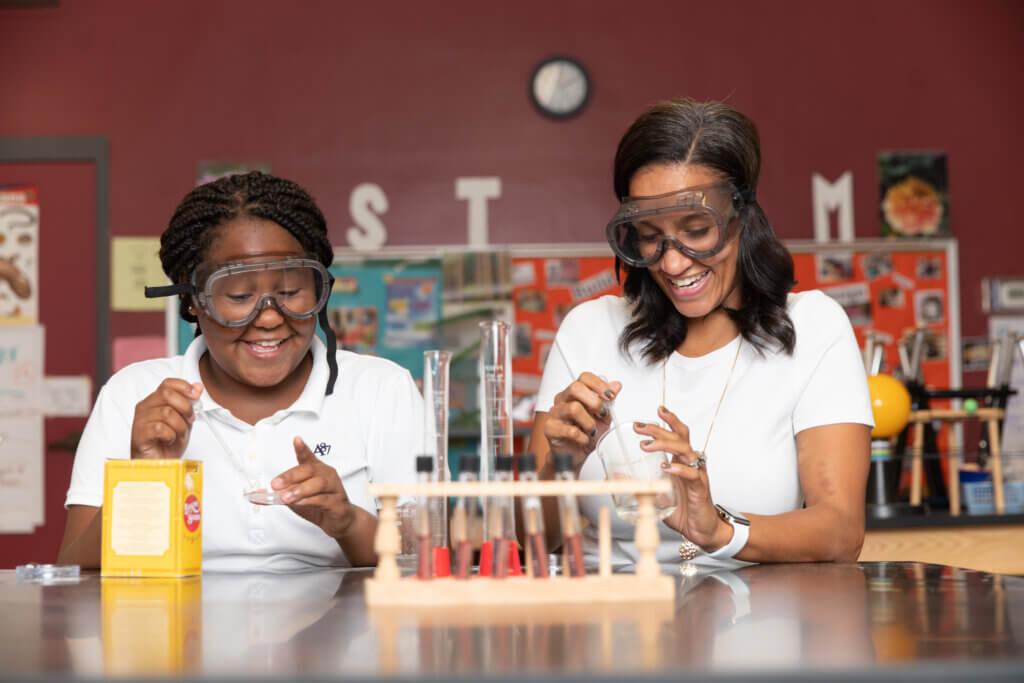
While most mentoring programs are not centered around a science activity curriculum, there are some lessons here that any mentoring program can learn. One is to give mentoring relationships plenty of time and space to just talk, to engage in dialogue about what’s happening in each other’s lives and in their communities. This can be hard to do in a program that is focused on skill-building and getting through that day’s complex activities. But taking that time can build trust and connection that makes the rest of the mentoring and learning more engaging and impactful.
Another key lesson from this study is to think about the culturally responsive practices that are relevant to your program. How do your mentors explain concepts or teach new skills? Are they doing that in ways that connect to the experiences, values, and cultures of the youth being served? Do they ask mentees for their opinions and seek out their strengths and talents as they engage in activities? Asking about how they go about building connection and “what works” from their perspective can identify key practices that can be taught to the next cohorts of mentors.
Lastly, all mentoring programs should explore how the mentoring experience is changing their volunteer mentors. What have they learned about themselves? How has the experience shifted their perspectives or changed their own pathways? Some simple surveys or focus groups can illuminate the mentors’ journeys and further illustrate program impact.
You can learn more about Science Club and the great work they are doing to build the next generations of STEM leaders and professionals at: https://scienceclub.northwestern.edu/.
References
- Garibay, C., & Schaefer, J. (2015). Science club: Summative external evaluation report. Garibay Group. Available online: https://tinyurl.com/sc-garibay-summative (accessed on 24 September 2024).
- Kennedy, M. T., Daugherty, R., Garibay, C., Sanford, C., Koerner, J., & Lewin, J. (2016). Science Club: Bridging in-school and out-of-school STEM learning through a collaborative, community-based afterschool program. Connected Science Learning, 1(1), 12420447.
- Pew Research Center. (2021). 6 facts about America’s STEM workforce and those training for it. Available online: https://www.pewresearch.org/?p=9087
- Sánchez, B., Sanford-Dolly, C., Chung, H., Garcia-Murrillo, Y., Thursby Bourke, K., Jarvis, N., Arsenault, A., & Kennedy, M. (2026). Culturally Responsive Practices in a Science Mentoring Program Serving Racially Minoritized Youth. Youth, 6(2), 66. https://doi.org/10.3390/youth6020066
- Stelter, R. L., Kupersmidt, J. B., & Stump, K. N. (2021). Establishing effective STEM mentoring relationships through mentor training. Annals of the New York Academy of Sciences, 1483(1), 224–243.