
• Federally Recognized Tribes (Quiz)

    [h5p id=”1″]

  • Tribal Diversity

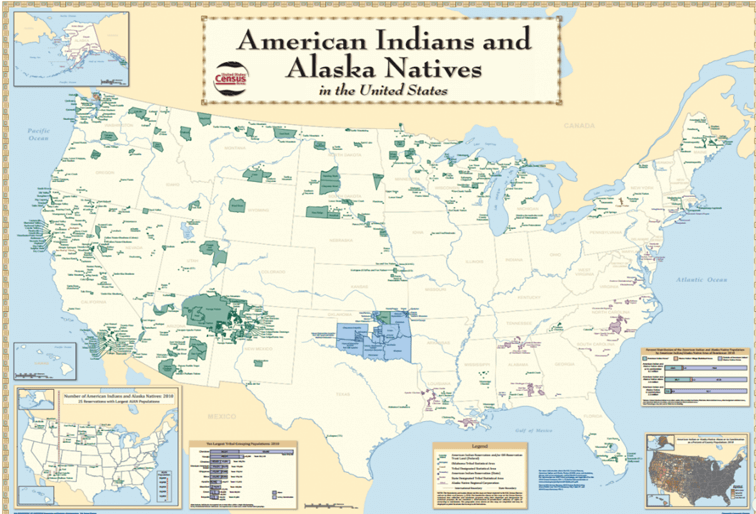
    U.S. Census (2010). 2010 American Indians and Alaska Natives in the United States map

    As of 2018, AI/AN youth were members or descendants of 573 federally recognized tribes

    About 229 of these nations are in Alaska.²

    There are also hundreds of tribes that are not federally recognized. To show the vast diversity of tribes in North and South America, cartographer Aaron Carapella creates maps that show tribal nations in their own names and locations pre-contact with European settlers.

    Learn more about the creation of the Tribal Nations Maps:

    1. About the Tribal Nations Maps
    2. NPR (2014). “The Map of Native American Tribes You’ve Never Seen Before”

    1. Bureau of Indian Affairs (2018). Frequently Asked Questions, “What is a federally recognized tribe?”. Retrieved from: https://www.bia.gov/frequently-asked-questions
    2. National Congress of American Indians (2015). Tribal Nations and the United States: An Introduction. Retrieved from http://www.ncai.org/about-tribes

  • Sovereignty

    There are three types of sovereign governments in the United States: the federal government, state governments, and tribal governments.

    • The federal government derives its power from the people—its voting citizens.
    • State governments derive their sovereign power from the federal government.
    • Tribal nations derive sovereignty from the people, the land, and their relationships; tribal sovereignty was not a gift from any external government.
    • Although it is not defined by the Constitution, it is recognized by the Constitution.

    Indian Nations exercise their inherent right to self-governance. Through tribes’ sovereignty, they interact independently in government-to-government relationships with other tribes, states, the federal government, and other countries’ governments. Additionally, tribes interact with school districts, cities, municipalities, businesses, nonprofits, nongovernmental organizations, higher education institutions, and more. Tribal sovereignty encompasses legal, cultural, political, historical, and contemporary traditions, which are connected to both European and Indigenous philosophies in complicated ways.

  • Sovereignty (continued)

    Chief Justice John Marshall defined tribal sovereignty in Cherokee Nation v. Georgia (1831). He said tribes are “domestic dependent nations.”

    • “Domestic” means tribes are within U.S. boundaries.
    • “Dependent” means tribes will always have a dependency on the federal government.
    • “Nations” means tribes are separate entities from the U.S. and have their own government.

    As sovereign nations, tribes maintain the power to determine their own governance structures, as well as enact and enforce laws. The responsibility of tribal government is to strengthen and protect tribal sovereignty, natural resources, cultural preservation, and the health and economic well-being of its people. Tribal governments provide essential programs and services, including (but not limited to) social programs, education, economic development, and land management. They also build and maintain a variety of infrastructure, including roads, bridges, and public buildings.

    tribal government visual
  • Impact of Federal Policies

    Many federal policies and laws impact tribes—and every aspect of life for AI/AN people. Early federal policies and laws were built on the foundations of settler colonialism and religion. Later policies and laws were enacted to repeal treaty rights. The ongoing devastating effects of these policies and laws on the health and well-being of tribal people is intergenerational, widespread, and universal; every AI/AN person and community is impacted. Policies led by tribal nations serve to restore and protect sovereignty.

    Several important periods of history to be aware of are:¹

    • Colonization Period (since 1492)
    • Removal, Reservation, and Treaty Period (1828–1887)
    • Allotment/Assimilation Period (1887–1934)
    • Tribal Reorganization (1934–1945)
    • Termination (1945–1968)
    • Self-Determination (1968–2000)
    • Nation-to-Nation period (2000–present)

    To learn more about each of these periods, take some time to review pages 12 and 13 of Tribal Nations And The United States: An Introduction from the National Congress of American Indians.

    1. National Congress of American Indians (2015). Tribal Nations and the United States: An Introduction. Retrieved from http://www.ncai.org/about-tribes.
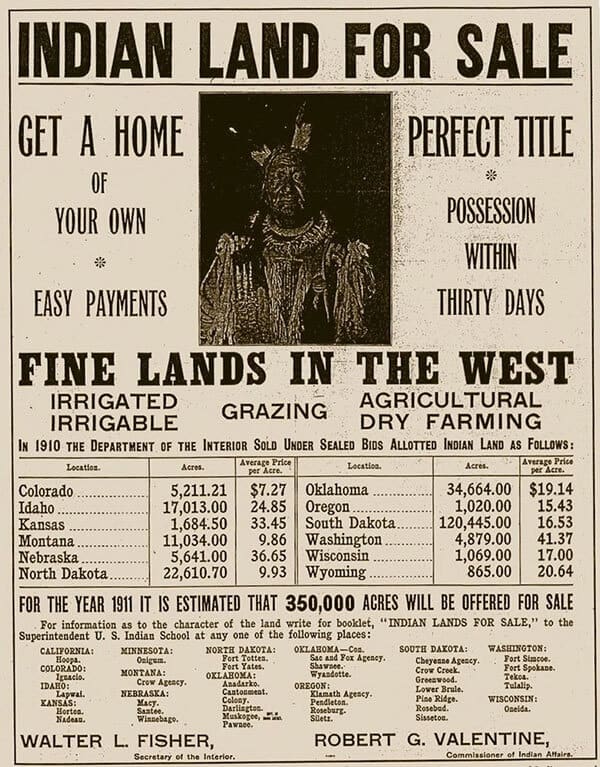
    Advertisement for the sale of land to whites under the Dawes act of 1911. United States Department of the Interior [public domain] via Wikimedia Commons.

  • Statements in Context
    Shadiin Garcia PhD, Critical and Sociocultural Studies in Education

    Shadiin Garcia is Chicana and Laguna Pueblo from New Mexico and has worked in the educational arena for over 20 years as a teacher, as a public school administrator, researcher, a policy analyst, and as a consultant. Listen to this introduction from Dr. Garcia about the importance of considering context.

    Consider the following statements that reflect common statistics you might read or hear about AI/AN youth. Click each box to reveal additional context about the statement from Dr. Garcia.

    “AI/AN youth have a higher incidence of absenteeism and discipline referral issues.”

    “AI/AN youth have higher dropout rates.”

Back

Return to the Introduction of The Landscape

The Landscape

Continue

Continue onto The Landscape: Application

The Landscape: Application

  • Download Now
    Please select all that apply
  • MENTOR National and Affiliates will use the information you provide to better inform future publications and keep you up to date with advancements in the mentoring field. For more information, check out our privacy policy.

  • Download Now
    Please select all that apply
  • MENTOR National and Affiliates will use the information you provide to better inform future publications and keep you up to date with advancements in the mentoring field. For more information, check out our privacy policy.