
How to Create a Community of Belonging Through Mentorship
April 8, 2025
Mentoring Partnership, Mentoring Stories
This blog is part of a three-part series, where we explore building a sense of community through mentorship with our partners at Foundry10. Read part two and three.
Mentorship is often seen as a way for experienced individuals to guide and support those who are newer to a particular journey. However, the act of mentoring is not one-sided. It can be a reciprocal experience that allows both the mentor and mentee to learn and grow together. Through mentorship, we have the ability to cultivate communities that nurture belonging, empowerment, and support — ultimately helping youth to thrive in all aspects of their lives.
One organization that has been a leader in creating such communities is Young Women Empowered (Y-WE), a Seattle-based nonprofit that cultivates the power of diverse young women and gender expansive youth to be creative leaders and courageous changemakers through transformative programs within a collaborative community of belonging.
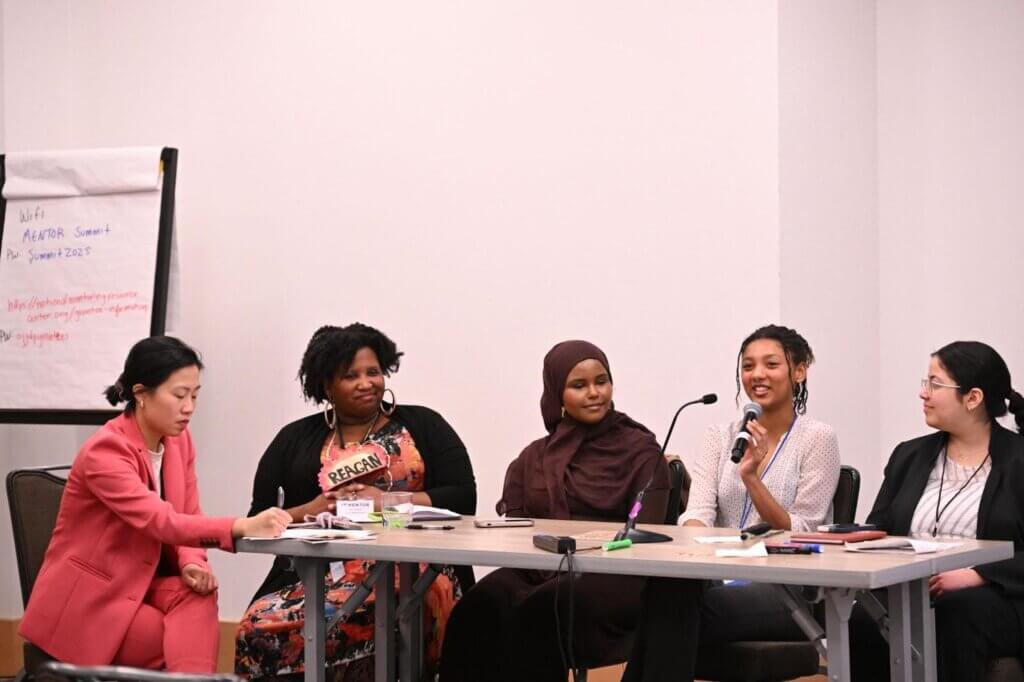
Y-WE recently presented a workshop at the 2025 National Mentoring Summit convened by MENTOR with foundry10, an education research organization based in Seattle. For the past nine years, Y-WE has partnered with foundry10 to conduct research on the impact of their programming. The interactive workshop titled “The Magic of Young Women Empowered: Cultivating Youth Leaders Through Intergenerational Mentorship,” featured the following workshop co-leaders:
- Fatra Hussein, a junior in high school in Seattle. She has been involved with Y-WE since she was 13-years-old. First, as a participant of the Y-WE Write program, and then as part of the Youth Leadership Council (YLC). In her first year of YLC, Fatra helped organize a Black Girls Matter Day of Wellness and then as her leadership project organized a Muslim Girl Day of Wellness. The event was so popular she did it the following year as well.
- Indigo Mays, a rising freshman at Howard University majoring in Political Science. For four years she has participated in Y-WE programs: Write, Create, Black Girls Matter Mentorship Program, Youth Leadership Council, and Cultural Kitchen. She has reported stories on local radio station KUOW, and hopes to manage public policy and advocacy for an organization in the future.
- Fatema Metwally, a junior at the University of Washington Seattle, double majoring in Human Resources and Information Systems. She has been involved with Y-WE since her junior year in high school. First, as a participant, and then in her Freshman year of college as the Co-Teaching Artist of Y-WE Speak.
- Reagan Jackson, Co-Executive Director of Young Women Empowered.
- Helen Lee, Principal Investigator of the Youth and Educator SEL Lab, foundry10.
Below, we’ll dive into key insights from the workshop, explore Y-WE’s mentorship model, and offer evidence-based approaches to creating a community of belonging for youth and mentors.
Y-WE’s Mentorship Model: A Unique, Reciprocal Approach
As Co-Executive Director of Y-WE, Reagan works with her team to train and support over fifty mentors and facilitators annually on best practices for adult allyship, healthy boundaries for youth work, disability justice, risk management, creating an inclusive community of belonging, and modeling creative risk.
Y-WE’s mentorship model is rooted in the belief that both mentors and youth learn and grow alongside each other. This reciprocal mentorship nurtures the personal and professional development of both groups.
Y-WE practices a research-backed group model of mentorship as opposed to solely one-on-one pairings. This approach provides youth with frequent structured and unstructured opportunities to connect with a diverse array of supportive adults and youth leaders. For example:
- Youth and mentors work together in group settings: Youth work together and alongside adult mentors and other youth who offer social, emotional, and skills-based support, including how to seek help from others as needed.
- Youth initiate match-ups: Match-ups are based on the youth’s individual comfort and needs, allowing for more personalized guidance and individual agency. Mentors regularly check in with youth while participating in programming with them, which helps youth know that mentors are available to support them when they may need it.
- Youth engage with multiple mentors: This group mentorship model supports youth agency in choosing who they connect with, broadening their support network.
“Y-WE’s unique approach to mentorship and facilitation allows for a genuine connection between youth and adults which remains respectful on both ends. The Black Girls Matter Cohort of 2022 especially encouraged me to grow in ways that are specific to my experience as a Black cis-woman, along with giving me tools to persist and survive in spaces that are hostile to my existence,” said Indigo.
Read foundry10’s recent journal article exploring the development of adult mentors at Y-WE summer camp, “This is Why We All Show Up”: How Supporting Youth Cultivates Hope, Purpose, and Well-Being of Adult Mentors,” in the Journal of Community Psychology.