• AI/AN Identities are Complex

    AI/AN youth are members or descendants of over 573 tribal communities.¹ It is not possible to say that there is one standard way of working with AI/AN youth. Some important points to be aware of when working with AI/AN communities include:

    • Not all people who identify as AI/AN live on or near their reservation.
    • Not all people who identify as AI/AN are enrolled in a tribe or nation.
    • Some people who identify as AI/AN will have limited or no contact with their AI/AN heritage and traditions.
    • Some people who identify as AI/AN are multiracial.
    • Not all people who identify as AI/AN can be identified by their physical appearance.
    • AI/AN identities are shaped by many complex social, political, historical, and cultural factors.
  • AI/AN Identities are Complex (continued)

    In examining AI/AN identity development, Perry G. Horse identifies five ways of how Native consciousness is influenced

    1. How well a person is grounded in the Native language and culture
    2. Whether a person’s genealogical heritage as an Indian is considered valid
    3. Whether a person embraces a general philosophy or worldview that derives from distinctly Indian ways, that is, old and current traditions
    4. The degree to which a person thinks of themselves in a certain way, that is, one’s own idea of self as an Indian person
    5. Whether a person is officially recognized as a member of an Indian tribe by the government of that tribe


    ¹ Horse (Kiowa), P. G. (2005), Native American identity. New Directions for Student Services, 2005: 61-68. doi:10.1002/ss.154
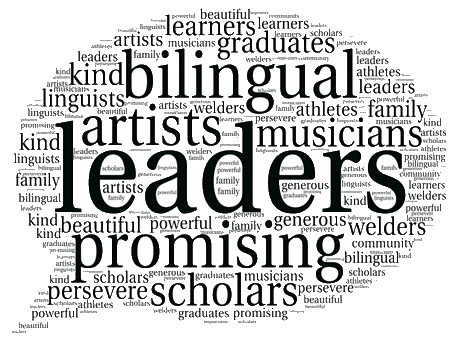
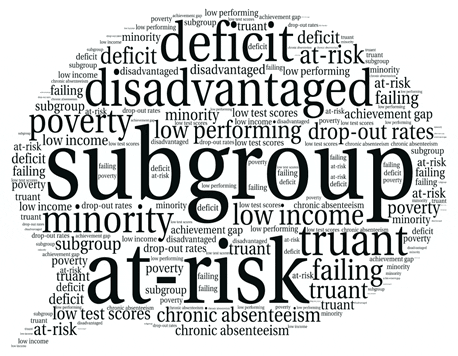
  • Strengths-Based vs. Deficit-Based Approach
    Review the two lists of words. Which do you most often see associated with AI/AN communities?
    • Minority
    • At-risk
    • Poverty
    • Alcoholics
    • Low-performing
    • High dropout rates
    • Truancy
    • Leaders
    • Bilingual
    • Artists
    • Family-oriented
    • Kind
    • Generous
      Scholars
  • Strengths-Based vs. Deficit-Based

    Deficit-based thinking is the practice of having lower expectations for certain groups based on their demographics or characteristics. This forms an “at-risk” narrative in which students navigating poverty, students of color, and/or historically underserved groups and their families are most often discussed in terms of deficits. For youth, repeatedly hearing their identity framed around deficits can be damaging.

    An asset-based or strengths-based way of thinking means recognizing and amplifying the strengths each person brings to the community. It’s good to be aware of historical context and issues that disproportionately impact Native communities, but we invite you to take a strengths-based approach to support and inspire Native youth through mentoring.

  • Critical Orientations

    In “Critical Orientations for Indigenous Studies Curriculum,” Dr. Leilani Sabzalian from the University of Oregon provides a framework for how we can emphasize the strengths and also acknowledge the complexities of Native identity. Consider these five orientations (or the Five P’s) when interacting with AI/AN communities:

    • Place: Recognize that you are always on Indigenous lands.
    • Presence: Interrupt the narrative that implies Native people have vanished.
    • Perspectives: Seek out Indigenous perspectives.
    • Political Nationhood: Acknowledge that Indigenous peoples have inherent sovereignty, political nationhood, varied citizenships, and descendants.
    • Power: Highlight examples of Indigenous power.
  • Critical Orientation: Place

    Place: Recognize that you are always on Indigenous lands.

    • Acknowledging Native homelands is a fairly common Indigenous protocol that conveys diplomacy and respect.
    • Learn the Indigenous names of the land you are on so you can respectfully identify the traditional peoples and homelands of that place.
  • Critical Orientation: Presence

    Presence: Interrupt the narrative that implies Native people have vanished.

    • Remember that Native people are a vibrant part of our communities today.
    • There are 573 federally recognized tribal nations in the U.S.¹ This does not include the tribes that have not been recognized but nevertheless have been here since time immemorial.
    • Ninety percent of AI/AN students go to public schools.²
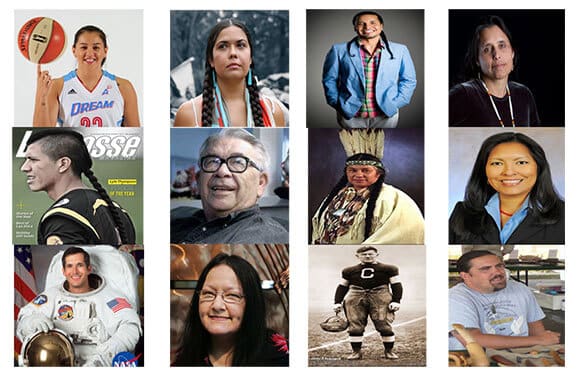
    • Learn about contemporary Indigenous leaders and their contributions.


    1. Bureau of Indian Affairs (2018). Frequently Asked Questions, “What is a federally recognized tribe?”.
    2. DeVoe, J.F., and Darling-Churchill, K.E. (2008). Status and Trends in the Education of American Indians and Alaska Natives: 2008 (NCES 2008-084). National Center for Education Statistics,
      Institute of Education Sciences, U.S. Department of Education. Washington, DC.
  • Critical Orientation: Perspectives

    Perspectives: Seek out Indigenous perspectives.

    • Monacan poet Karenne Wood reminds us, “Nothing was discovered, everything was already loved.”
    • Consider that everything here—the rocks, the trees, the rivers, the land, the animals, the people—already had names, lives, and stories before colonization.
    • Instead of learning about Native people, how can you learn from Native perspectives and analyses?
  • Critical Orientation: Political Nationhood

    Political Nationhood: Acknowledge that Indigenous peoples have inherent sovereignty, political nationhood, varied citizenships, and descendants.

    • Consider the tendency to frame Native people as strictly cultural. Although Native people may be people of color, they also have political identities as citizens or descendants of tribal nations.
    • Tribal nations are governments, just like local, state, and federal governments.
    • Hillary Clinton is often talked about as the first female candidate for president of the United States, but many tribal nations have women leaders.
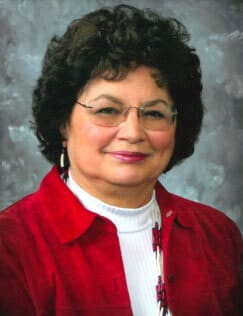
      • Delores Pigsley has been the chairman of the Confederated Tribes of Siletz Indians of Oregon since 1983.
      • Brenda Meade is the chairperson of the Coquille Indian Tribal Council.
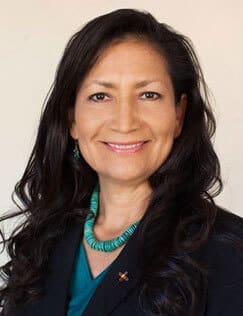
      • Deb Haaland, a member of the Pueblo of Laguna, won the Democratic nomination for New Mexico’s 1st Congressional District.
    • When talking about tribal leaders, refer to them as elected government officials.


    Delores Pigsley

    Brenda Meade

    Deb Haaland

  • Critical Orientation: Power

    Power: Highlight examples of Indigenous power.

    • Although it’s important to acknowledge the ways in which AI/AN youth have been marginalized, avoid framing Indigenous peoples as “damaged.”
    • Share and learn more about examples of collective Indigenous power, creativity, and agency, such as:
      • Political and environmental activism efforts (e.g., Standing Rock).
      • Native entrepreneurs who are opening businesses that serve Indigenous traditional foods.
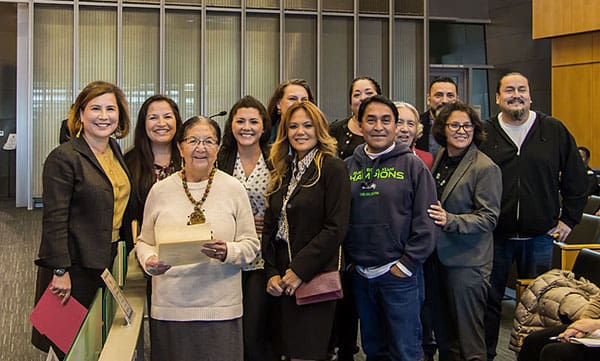
    [Tribal leaders receive a proclamation to declare November “Native American Heritage Month” in the City of Seattle. November 26, 2016. Wikimedia Commons]

Back

Return to the Introduction of Native Youth Identity

Native Youth Identity

Continue

Continue onto Native Youth Identity: Application

Native Youth Identity: Application

  • Download Now
    Please select all that apply
  • MENTOR National and Affiliates will use the information you provide to better inform future publications and keep you up to date with advancements in the mentoring field. For more information, check out our privacy policy.

  • Download Now
    Please select all that apply
  • MENTOR National and Affiliates will use the information you provide to better inform future publications and keep you up to date with advancements in the mentoring field. For more information, check out our privacy policy.